
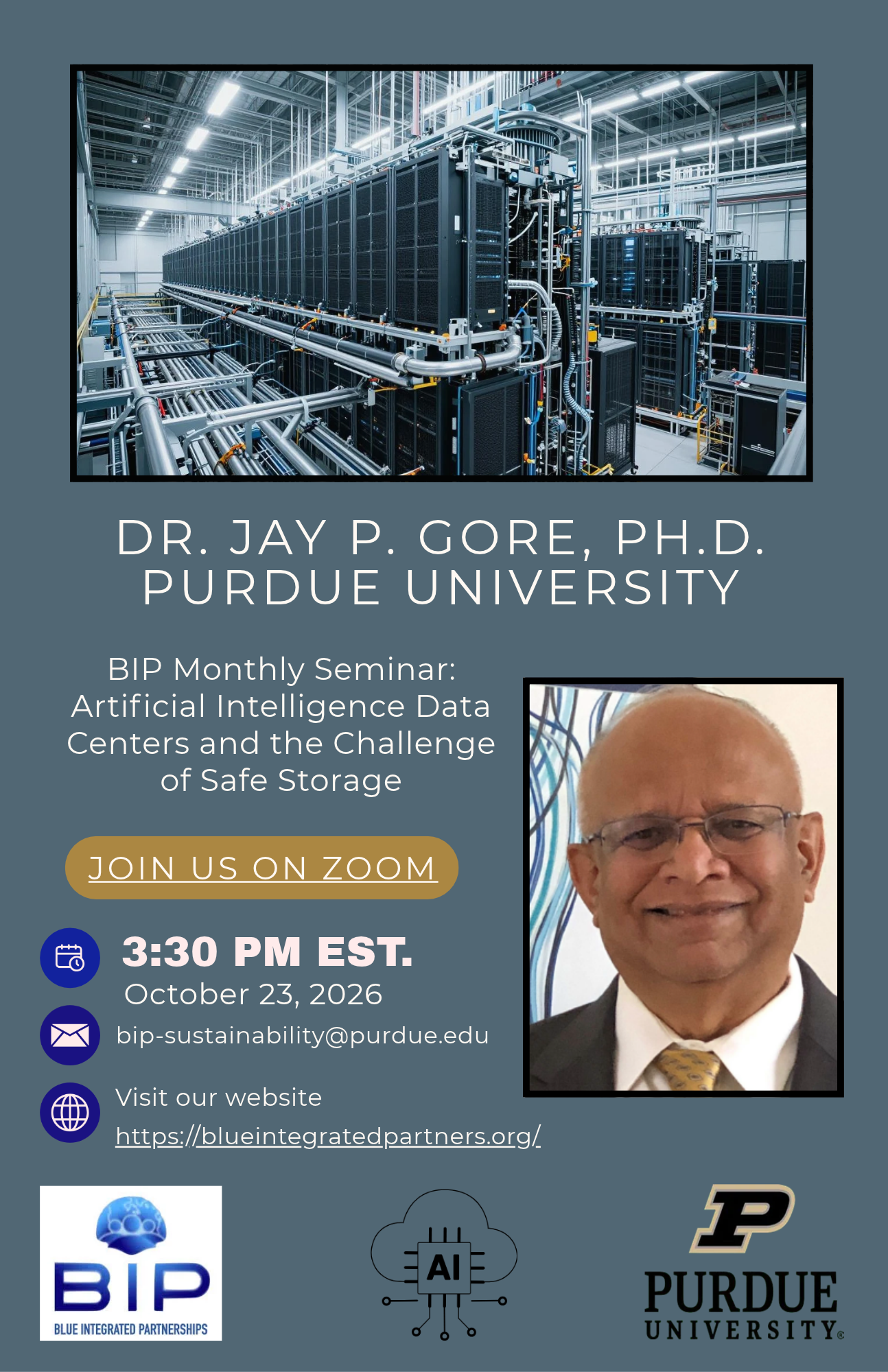
Jay P. Gore
Purdue University
Artificial Intelligence Data Centers (AIDC) supporting the modern revolution vary in
the necessary cooling capacity between 5-10-40 kW to 30-140-200+ kW and even to 2000
kW. The cooling at the lower capacity range is managed by Computer Room Air
Conditioning (CRAC) and Computer Room Air Handlers (CRAH) involving high velocity
fans and raised floors. Rear Door Heat Exchangers (RDHx) involving chilled liquid and
facility water loops work for typical heat power dissipation between 20-40 kW. Direct to
Chip Cooling (DLC) involving cold plate manifolds and in-row coolant distribution units
(CDUs) are utilized for heat power dissipation in the 30-200 kW range and immersion
cooling is essential for heat power dissipation over 200 kW and even up to 2000 kW.
Optimization using warm water technology has become essential. The Megawatt (MW)
level heat power dissipation is in fact an attractive source for mature technologies like
thermoelectric generation. Entransy and Exergy are the best performance metrics for
AIDC and the Energy Reuse Factor (ERF) defined as the ration of the reused energy to
the total facility energy is the closest ISO/ISE metric. The diverse architectures,
technologies, local weather, and surroundings call for cooling algorithms based on
augmented intelligence (AI) defined as human intelligence (HI) supported by artificial
intelligence (AI).
Biography:
Professor Jay Gore is the Reilly University Chair Professor within the School of
Mechanical Engineering at Purdue University in West Lafayette, IN, USA. He served as
the Associate Dean of Research and Entrepreneurship within the College of Engineering and
founded the award-winning Summer Undergraduate Research Fellowships (SURF) program.
He was the inaugural Vice Chancellor of the MIT World Peace University in Pune, India.
Gore has served as a Jefferson Science Fellow in the U. S. Department of State
working on Sustainability and Climate Change. Amongst his many awards are the U.S.
Presidential Young Investigator (PYI) award (1991), the Arden Bement Award (2022), the
ASME James Harry Potter Gold Medal (2025) and the ASME Holley Medal (2026). Jay will
discuss affordable and deployable software and hardware solutions from capital and
operating expenses (CapEx and OpEx) perspectives to the data center sustainability
and societal acceptance problems. These include hardware and software solutions like
warm water cooling, thermoelectric generation, and enhanced exergy and entransy efficiencies.
Professor Jay P. Gore, Ph.D.
Email: gore@purdue.edu
Web: https://engineering.purdue.edu/ME/People/ptProfile?resource_id=9892
Join us on zoom: https://purdue-edu.zoom.us/j/98329863384